The Making Of An Icon: Sting's First World Title Win At Great American Bash 1990
The true story of Sting's first world title win

Dec 17, 2025

The true story of Sting's first world title win
Dec 17, 2025
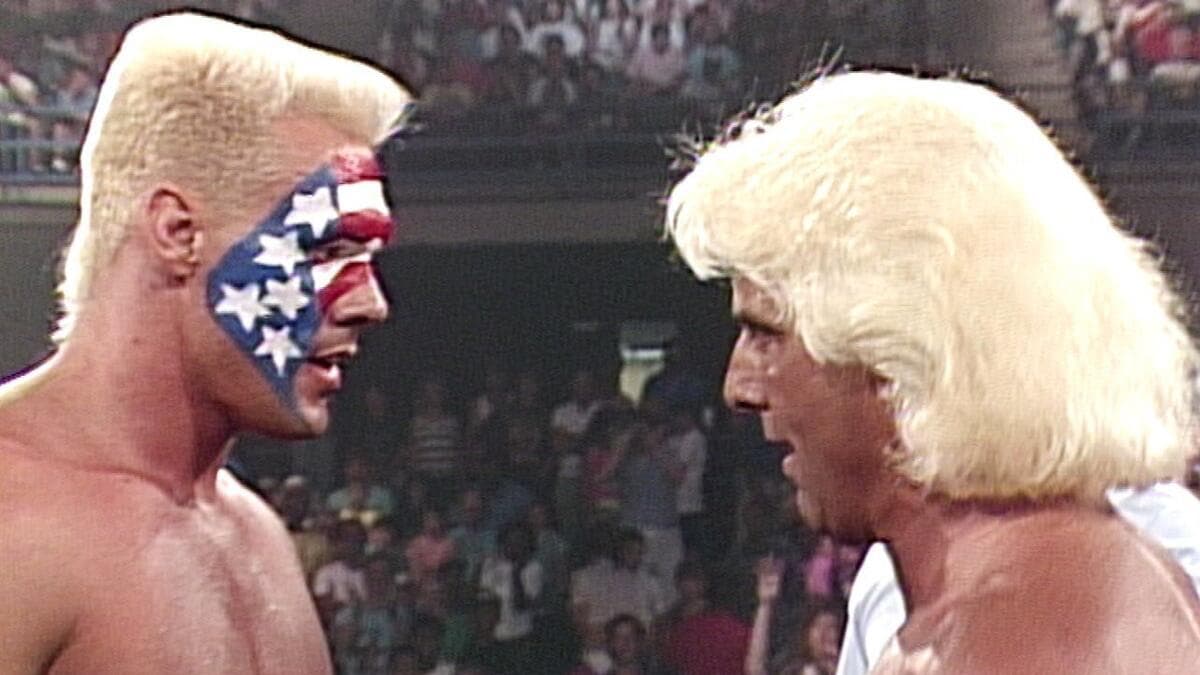
For the better part of nearly 40 years, Sting was one of pro wrestling's pre-eminent protagonists, enjoying prominent runs in WCW, TNA, and AEW, while captivating the minds of several generations of fans with his enigmatic presence.
In his storied, championship-filled career, Sting held world titles on 14 occasions, making him one of the industry's most decorated headliners. His collection of top championships had to begin somewhere, and that somewhere was Baltimore, Maryland on Saturday, July 7, 1990 at the Great American Bash.
On March 27, 1988, the general main event scene of contemporary professional wrestling changed forever. In the WWF, the increasingly-popular "Macho Man" Randy Savage won his first recognised world title, capturing the vacant belt by defeating Ted DiBiase in a tournament final at WrestleMania IV in Atlantic City. With Savage's win, the WWF hitched their wagon to the first long-term world champion not named Hulk Hogan in more than five years.
Meanwhile, on the same date in Jim Crockett Promotions a new main event star in their own right emerged. After having two pay-per-view efforts railroaded by spiteful WWF counter-programming, Crockett decided turnabout was fair play. On March 27, he staged the first ever Clash of the Champions on TBS, offering a free supercard to counter the WWF's premium broadcast.
When it came to assembling the Clash of the Champions card, booker Dusty Rhodes was in something of a precarious spot, however, as he needed to book someone that could credibly challenge NWA Worlds Heavyweight Champion Ric Flair for the Ten Pounds of Gold, but he also couldn't give away a supercard-calibre match for free, since house show business was largely the territory's bread and butter.
For the role of Flair's challenger, Rhodes went with a still-ascending up-and-comer, one that some figured was due for an eventual breakthrough.
Steve Borden had been in the wrestling business for under three years, having begun his career as one half of the Blade Runners with Jim Hellwig - the future Ultimate Warrior - in the Continental Wrestling Association. The team soon moved to Bill Watts' UWF, however, and when Hellwig left in 1986, Sting remained a heel tag team wrestler, teaming with Eddie Gilbert and Rick Steiner as part of Gilbert’s Hot Stuff International faction.
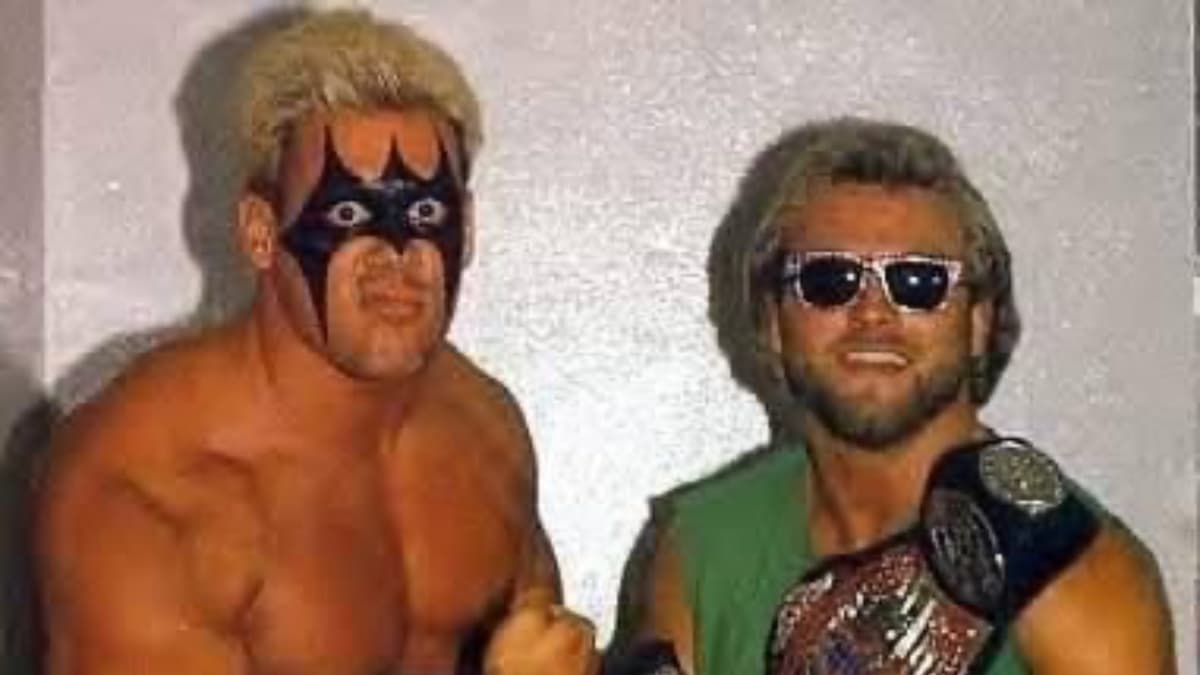
Gilbert was a big fan of Sting's and believed he had the potential to be a top babyface. The musclebound youngster had an obvious magnetism, a physical charisma that didn't manifest in pointed promos, but rather in sheer presence. The face paint, the flattened coif of light blonde hair, the chiseled build, the extroverted personality, and an astute heavyweight grace - Sting just had "it."
Sting’s breakout moment in the UWF arrived in the summer of 1987 as during a match with Terry Taylor, Eddie Gilbert interfered to help Taylor, costing Sting the match. A beatdown then followed until Chris Adams made the save, with The Stinger ultimately siding with Adams and turning on his stablemates in the processs.
Sting’s ascent up the card wasn’t guaranteed, however. Plans called for Borden to win the UWF Television Championship held by Eddie Gilbert, but Jim Crockett Promotions acquired the UWF in 1987 and the Television Title ultimately went to Terry Taylor before the belt was unified with the NWA Television Championship.
Sting wasn't buried following the JCP acquisition, but he didn't immediately have the rocket strapped to his back, either. He worked a six-man opener at the 1987 Starrcade, and, once the calendar flipped to 1988, was relegated to a dark match at Bunkhouse Stampede.
That didn’t mean JCP didn’t see his potential, however. On camera, Sting may have been a moderately-pushed babyface, but off-screen, there were designs on testing him at the top level. On house shows beginning in late-1987, Sting worked NWA World Title bouts with Ric Flair, either losing to the champion or scoring DQ wins in cities like Chicago and Atlanta.
That first run of house show bouts stretched from December into March, so whenever it was decided that Sting would get this big Clash match with The Nature Boy, nothing in those house show outings deterred the company's plans.
On March 27, before 6000 fans at the Greensboro Coliseum, Ric Flair vs. Sting for the Ten Pounds of Gold went on last of the five televised bouts. The pair would have their work cut out for them trying to follow a fast-paced Midnight Express match with The Fantastics, and Lex Luger and Barry Windham's jubilant World Tag Team Title triumph over Arn Anderson and Tully Blanchard.
Sting and Flair were also tasked with going 45 minutes in what was a daunting challenge for the young Sting. While Flair was regarded the ideal ring general, Sting would more than hold up his end of the bargain. With Flair providing the instructions, Sting answered every single one with aplomb, looking every bit the worthy challenger to Flair's throne.
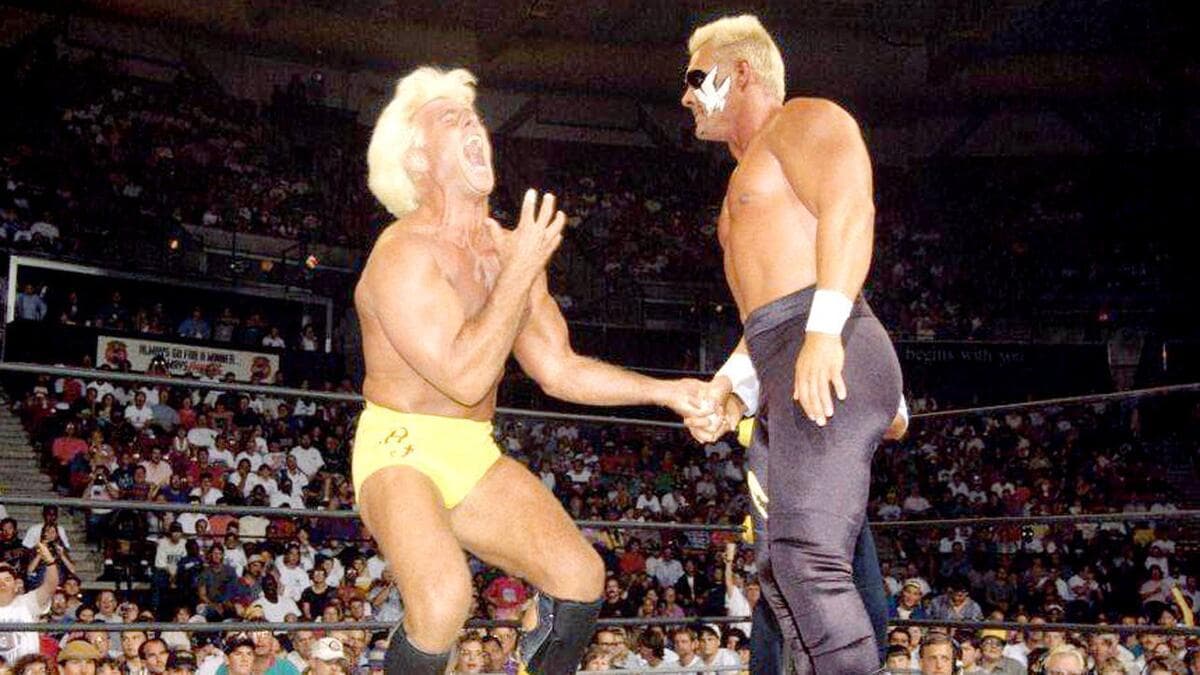
In the final stage, Sting trapped Flair in the Scorpion Deathlock, but the bell sounded as the champion was fighting against the current, signalling a time-limit draw after 45 long minutes. The match was an instant classic, one that Dave Meltzer rated four and three quarter stars. Many fans and critics came to a similar conclusion that Sting was one-half of a televised masterpiece.
Flair later went on to write of that historic encounter: "I could feel the mood of the people, and knew that they were buying Sting as my peer. So was I. Sting had the ability and loved wrestling so much that I knew that he was going to make it."
Some of the sentiment inside JCP was that they had a winner on their hands, perhaps their long-desired answer to Hulk Hogan's allure and popularity on the other channel.
Sting remained high in the JCP mix throughout the rest of 1988, teaming with prominent babyfaces like Dusty Rhodes and Nikita Koloff, while challenging for secondary championships.
With a sustained push, Sting's popularity continued to soar, so much so that when Dusty was faced with the difficult task of turning the uber-popular Road Warriors heel, he had them turn on Sting, believing that the Warriors would likely be cheered were they to attack any other babyface.
In 1989, in what was now Ted Turner's WCW, Sting finally struck gold, winning the Television Title from Mike Rotunda. He spent the ensuing months defending the belt against an emerging rival in The Great Muta, battling his face-painted counterpart in excellent matches over the summer of 1989.
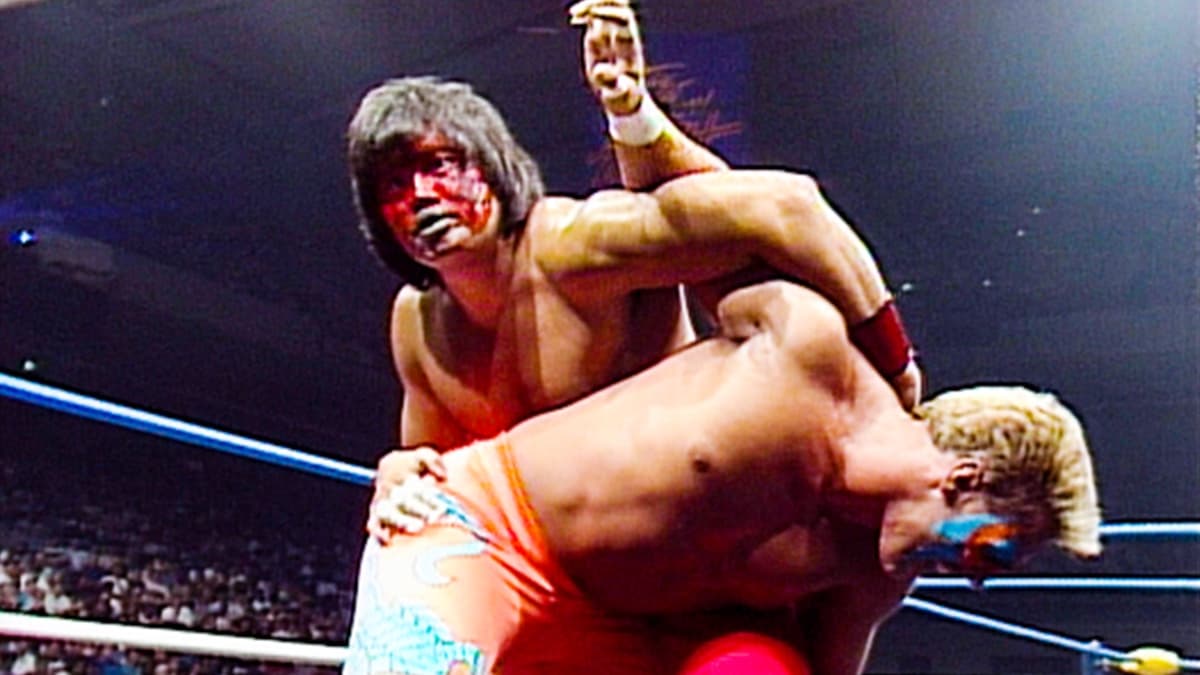
By this time, still-world champion Ric Flair had turned babyface, aligning with Sting against Muta, Terry Funk, and the rest of Gary Hart's J-Tex Corporation. Flair and Sting teamed together at October's Halloween Havoc to defeat Funk and Muta in a Thunderdome Steel Cage match, giving Sting his first ever win in a pay-per-view main event.
Then at Starrcade 1989, World Championship Wrestling staged singles and tag team round robin tournaments over the course of one night to determine who was the best wrestler in their respective divisions. The singles final ultimately came down to to Sting vs. Flair, with Sting needing a pin or submission win over Flair to win the tournament.
Though the NWA Worlds Heavyweight Title was not on the line, Sting scored his biggest career win to date by countering Flair's figure four attempt with an inside cradle, pinning his fellow babyface in dramatic fashion.
Just days before Starrcade, the Four Horsemen had reformed in WCW as a babyface faction of Flair, Arn Anderson, and senior member Ole Anderson. Shortly after 1990 began, Sting was named as the fourth member of the Four Horsemen, but there was already tension as Stinger had earned himself a world title shot at February's WrestleWar pay-per-view courtesy of his win over Flair at Starrcade 1989.
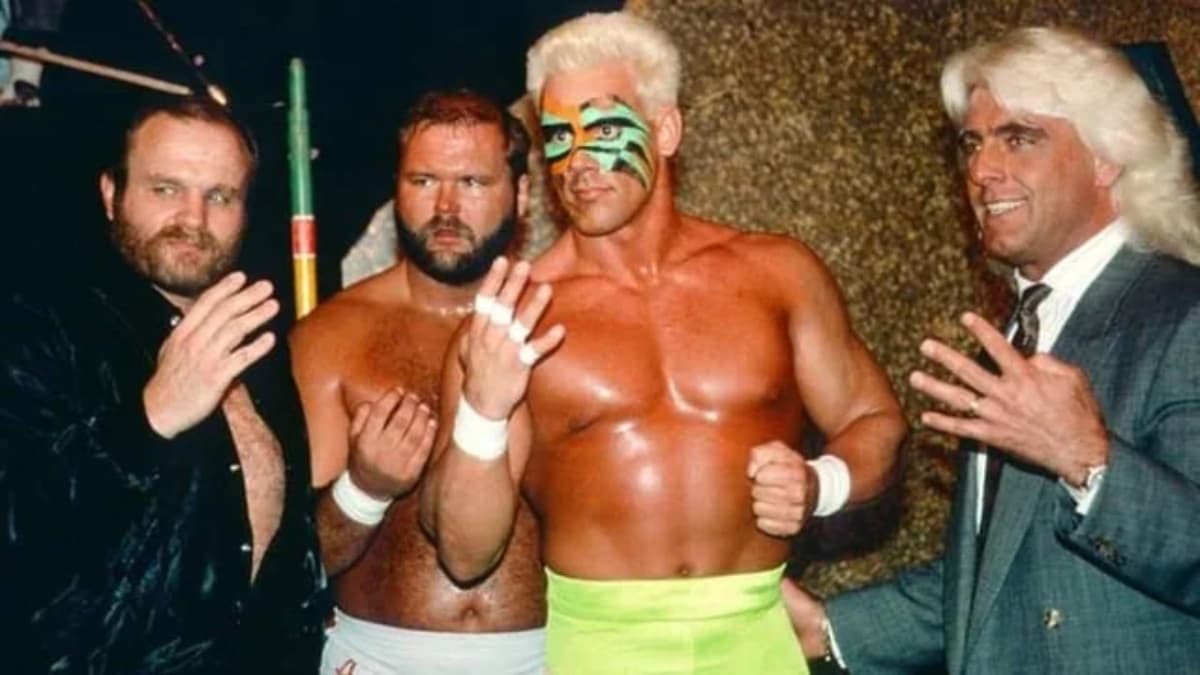
While the Horsemen were nominally babyfaces, to a fan familiar with the group's past treachery, it certainly looked like Flair may have been trying to manipulate, if not outright duck, the man that had just decisively pinned him in front of the world. Of course, that is exactly what was happening.
On February 6, 1990 at Clash of the Champions X, taking place three weeks before WrestleWar, Sting was kicked out of the Horsemen. After his supposed new friends ordered him to forfeit his impending title match, Sting refused, and was beaten down by Flair and the Andersons as a result.
Not only was the angle a strong piece of business, but the choice of pay-per-view venue was perfect. WrestleWar would take place at the same Greensboro Coliseum where Sting took Flair to the limit two years earlier, commencing his path to superstardom, and it looked nailed on that Sting would win the belt in the same venue.
Everything went wrong, however, in the main event of Clash of the Champions X. To continue the angle of being kicked out of the Four Horsemen earlier in the night, Sting interfered in the Steel Cage match of the Four Horsemen vs. Gary Hart International.
During the course of the wild melee, Sting blew out his knee, tearing his ACL. The injury apparently occurred when Sting was climbing the cage wall and Doug Dellinger, WCW’s head of security, went to restrain him from interfering. Dellinger reportedly pulled Sting down from the cage too harshly, causing the knee injury.
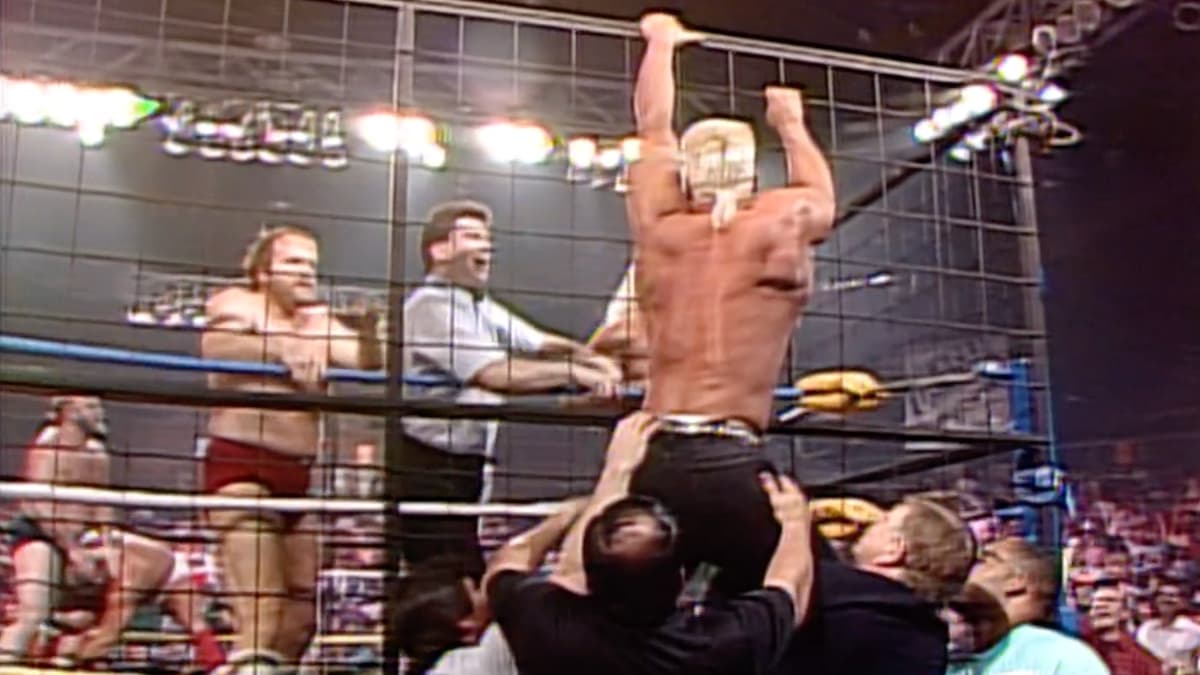
In an instant, the world title match for WrestleWar was off. Sting was going to miss several months of action, leaving a gaping hole in the main event picture.
With Sting sidelined, Luger was slotted in as Flair's challenger for WrestleWar. In a haste to make up for the loss of his top star, WCW EVP Jim Herd wanted to put Luger over at the pay-per-view, for the sake of surrogate catharsis. Flair refused, however, feeling it would be utterly wasteful to switch to Luger as the angle with Sting was ongoing. Come hell or high water, Flair said he was holding the title until Sting was ready, because that was the original plan.
Flair ultimately did retain the belt, outlasting Luger in a 38-minute battle, while crutch-bound Sting looked on. Flair retained the title once more over Luger at May's Capital Combat, losing via DQ inside a steel cage on the same show where Sting was rescued from a Four Horsemen ambush by Robocop.
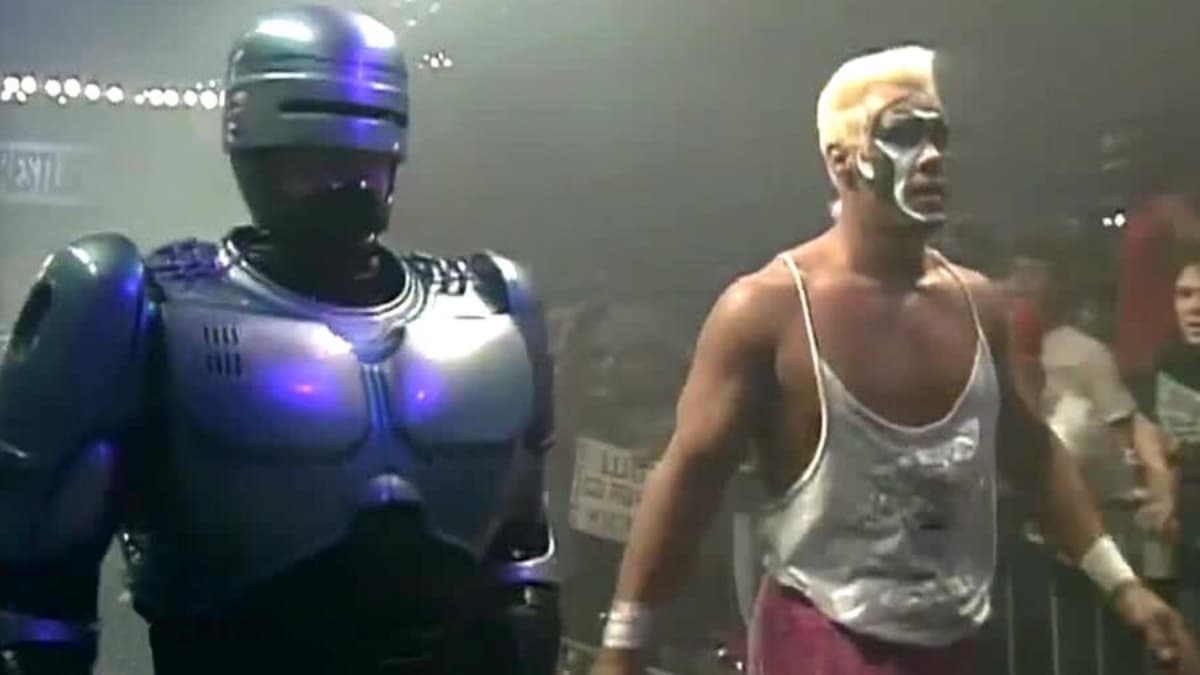
After a stint on the sidelines, it was made official in June that Sting would return at the Great American Bash on July 7 to challenge Ric Flair for the NWA Worlds Heavyweight Title.
The match would represent a major changing of the guard. Since September 1981, men not named Ric Flair had only held the NWA World Title for a combined 337 days, less than one year in all. Flair's six recognised reigns with the belt to that point, meanwhile, totalled in excess of 2800 days, more than seven and a half combined years. His present reign had been ongoing since May 1989, in itself an impressive 14 months in length.
Flair was the man of the 1980s, but he was now 41 years of age. Sting - 10 years his junior - was poised to rule the 1990s, the new leading man for the changing business. Sting looked the part of the superhero too as he arrived at the pay-per-view in star-spangled banner attire and war paint.
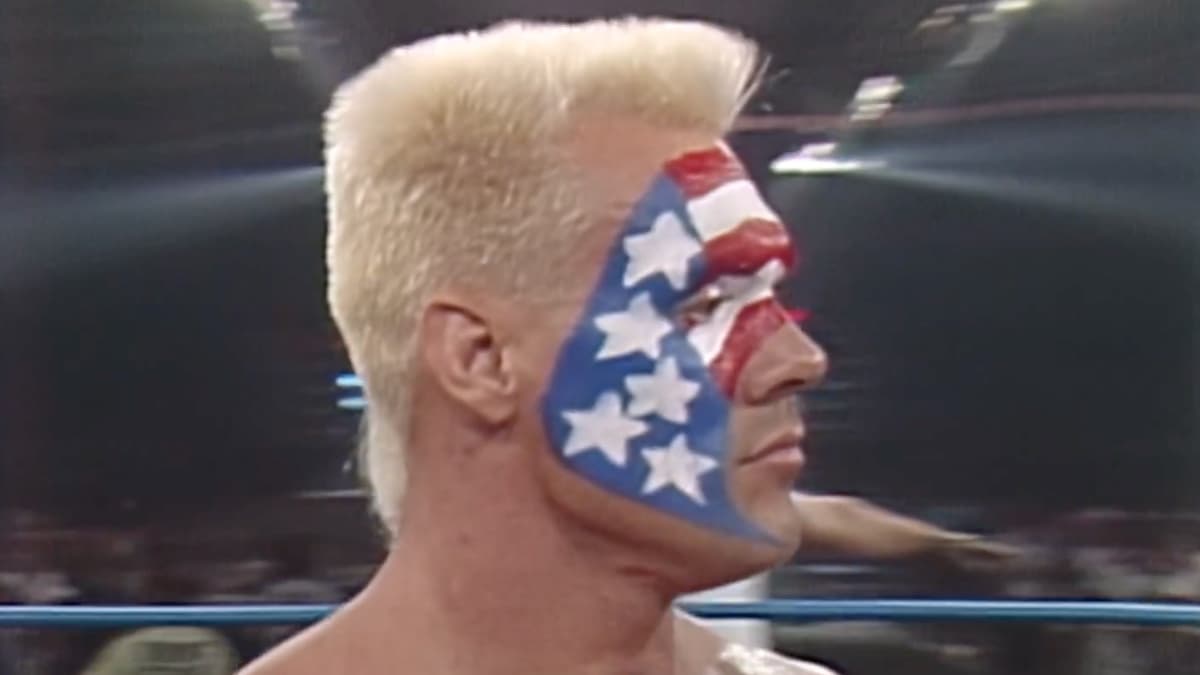
Not only would the crowd be right behind Sting, but the match’s set up seemingly neutralised any way for Flair to remain champion via nefarious means. The ringside area would be surrounded by a handful of babyfaces to prevent any interference from the Horsemen. Meanwhile, Horsemen puppet-master Ole Anderson would be handcuffed on the entrance stage to the recently-arrived El Gigante.
Sting and Flair's title bout began with the usual gusto, two fired-up pros at the top of their game. Flair tried to work over Sting's once-injured knee, but could never ignite a sustained blitz on the limb. Meanwhile, Sting shook off portions of Flair's offence to establish his seeming invincibility.
After almost 15 minutes, Sting commenced his finishing sequence, hitting the Stinger Splash and trapping Flair in the Scorpion Deathlock. The Horsemen all tried to rush the ring, only for Sting's allies to hold them at bay. However, Flair - after fighting the hold for a prolonged spell - managed to snag the bottom rope. Then, when Flair tried for a cheap pin with his feet on the ropes, Scott Steiner shoved Flair's boots off.
An exchange of near falls ensued, with Jim Ross' excited narration equaling the fervour of the fans in Baltimore. Sting then tried for a cross corner charge, but Flair moved, causing the challenger to hit his repaired knee against the buckle. Sensing opportunity, Flair went for the figure four, only for Sting - mirroring their Starrcade battle - to cradle him for the pin and the championship, beneath a hail of pyro and cheers.
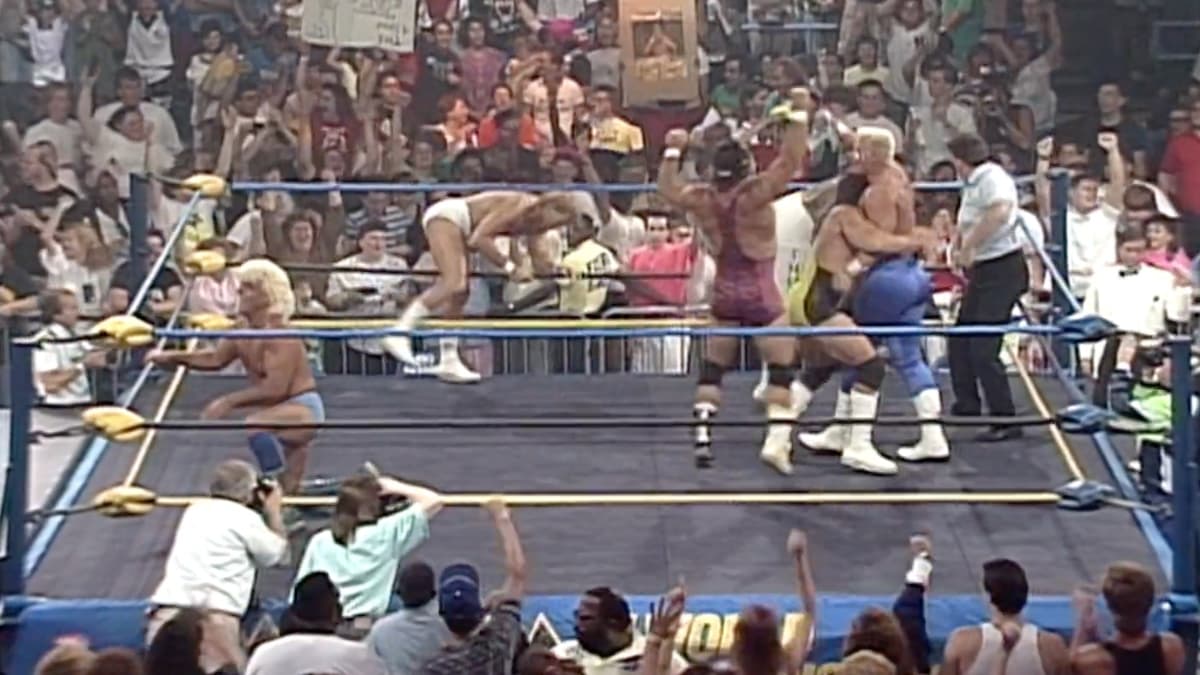
At 31 years of age, less than five years into his wrestling career, Sting was the NWA Worlds Heavyweight Champion, dethroning one of the industry's premier icons in grand fashion. The scene rates as one of WCW's all-time greatest moments, and almost inarguably the most positively-memorable moment of pre-Monday Night Wars WCW.
There was definitely an audience for the match, too. In addition to the healthy crowd of 14,000 on hand in Baltimore, 200,000 households purchased the Great American Bash, marking only the second time a WCW pay-per-view hit that threshold, and the last time until 1994.
After Great American Bash 1990, Sting accumulated 13 more world titles - some on pay-per-view, some on TV, some at house shows. Some of those wins were cathartic, others forgettable. One should have been cathartic, but the poor execution rendered it as ‘best-left-forgotten' in Starrcade 1997.
None of those title wins produced the same spark, invoked the same simple joy, as Sting's first. Many of the fans that rejoiced in Sting's victory were there for much of his ascent through the wrestling business in those few short years, rising up the card alongside growing fan appreciation. Due to that organic connection, Sting's championship coronation was especially satisfying to those that had backed him throughout his journey.
And yet, wrestling history as we know it would be very different had Flair dropped the belt to Luger, or anybody else, in Sting's injury absence. Flair being the near-eternal champion, and picking up a few more tainted wins along the way, only made Sting's triumph sweeter. Nobody else could have pulled the sword from the stone to that same effect.
In a near 40-year career filled with legendary moments and warm memories, Sting never looked more the part of world champion than on that day in July of 1990 when he was cemented as The Icon.